This post is by an Anonymous Guest Blogger
At first I thought, "What Did I Do Wrong?" Now, since I've been re-reading my instructions and the rubric, I can see much more clearly where my entry fell short last May. I look at the feedback I got and I see that it really was a level 2 entry that I sent in. I'm encouraged by others who didn't make it their first try. And I wonder, does the 80% pass rate with a cohort mean first time pass rate, or overall?
I notice my new videos and new writing, and, well, pretty much this whole year have had a deeper level of understanding. I'm teaching a lesson and I'm trying new things. Like differentiation. I thought that was how I was using new strategies, but now I'm thinking it's how I'm choosing the right strategies for each of my kids. This year I'm doing the same lesson with my kids, but I met with Joetta and she and I brainstormed what student engagement looks like and talked about how to make the lesson more student-centered. I'm excited about the changes I've made and I feel like I'm more mature somehow, as a teacher. I just feel better about everything. I will also say that there's just a lot more understanding about what I'm doing, now, with the whole process, too.
By this time next year I think I will be an NBCT, and I'll be volunteering to help others just like they've helped me. I will have words of wisdom to share. I like how one of my mentors said, "Welcome to the Re-do Club." I'm going to be an NBCT who has earned the right to use those letters after her name, just like all the other NBCTs out there.
Wednesday, January 24, 2018

Thursday, January 18, 2018
A Positive, Challenging Learning Environment Provides Success for All Students

by Stacie Atliff
This was first published on lifecoachforteachers.blogspot.com
This was first published on lifecoachforteachers.blogspot.com
In my first few years of teaching, it has become very clear to me that creating a positive and inviting environment is half the battle. While content and learning strategies tend to become the main goals, it is vital to realize these goals are more likely to be met when taught in a classroom where students feel safe. A place where students feel encouraged and independent too. After all, isn’t that also part of the learning process?
After taking my first initial high school job as a special educator, I quickly realized that the approaches that had worked with my middle school self-contained classes were not going to provide what was needed to encourage my high school students in a co-taught environment. Before, my reward system was a fairly successful tool that encouraged positive behavior. Now, I’m looking at students who are aware they are labeled “special ed” and aren’t as easy to encourage with stamps and small prizes.
Can positive rewards still encourage the students I currently teach? Absolutely. I continue to search for new tactics to implement, such as earning classroom roles or rewards chosen by students. But when is working for free time and other rewards not enough? When will we stop devaluing the feeling that comes from raw success?
This shift in thinking hit me like a freight train a few months into the school year when one of my students came up to me after class. He couldn’t contain his excitement as he told me he earned a B on a chapter test. Of course I already knew his score, but I let him have the excitement of telling me – excitement rarely seen from this particular student. The best part, however, is that I had proof that he actually put forth effort and got on our classroom app to study. In that moment, his excitement was from pure success. He wasn’t getting a “reward.” Instead, he had been rewarded with one of the best test grades he’d likely received in a long time. I wanted to bottle up his feelings as proof for future hard work because, this time, he didn’t guess for a B. He worked hard for that grade and he knew he had earned it.
Like too many other students, I realized, he hasn’t tasted enough success that comes from hard work and effort. This student, like so many others, comes to class with baggage that would weigh anybody down and create a lack of self-confidence. In the eyes of these students, failure is glaring right back at them because they have seen so many things go wrong. Isn’t it our responsibility to help them see things a different way? Are we helping them if we do not do what we can to help them actually feel success and use it as a motivational tool? From respecting authority and rules to passing a challenging class, writing a research paper, or being a good friend at the right time, students can feel success in various forms, both big and small with a little help and support.
Often times, these students are not praised or encouraged at home and may not know how good it can feel to do the right thing. Although they may not act like it, many of them are dying to form relationships and have somebody believe in them – even if they don’t know it yet. How can students aim for success when they have never achieved it from their own hard work? The solution seems simple, but the path to get there is far from that. Like most questions in the education world, there is not any one right answer but rather a list of strategies that will continue to grow and change. Regardless of the method, it seems that students are desperate at a chance to learn what success is for them and an opportunity to grow from this realization.
In addition to the positive reward systems or tactics used in the classroom, I want to incorporate a system of determination and respect – for others and oneself. A determination that can be strengthened by helping students achieve success inside and outside of the classroom. A new type of feeling – that hard work doesn’t have to impede the positive learning environment. Instead, classrooms can become a place where hard work is a positive in the eyes of the students because achieving success is a reward that is more than worthy. It may not help them all, but feeling success from their own hard work is something every student deserves to experience at least once on their journey. Who knows, they may even start to like it.
Monday, January 15, 2018
Blind Reader Program Available to Candidates
Guest Post by Cari Levake
Harrison County NBCT Support Cohort is excited to announce the Blind Reader Program, designed to support candidates as they develop the written portion of their components.
Our goal is to provide candidates with timely feedback from NBCT Readers. Candidates will be able to send their papers to a designated “Go Between”, who will forward it on to the Reader in order to keep both parties anonymous. The “Go Betweens” will be Elissa Whelchel and myself. We will keep track of the candidate’s number, the NBCT Reader, and the dates submitted as a means of accountability on all parts.
Our goal is to provide candidates with timely feedback from NBCT Readers. Candidates will be able to send their papers to a designated “Go Between”, who will forward it on to the Reader in order to keep both parties anonymous. The “Go Betweens” will be Elissa Whelchel and myself. We will keep track of the candidate’s number, the NBCT Reader, and the dates submitted as a means of accountability on all parts.
Here is more about how the program works:
STEP 1: The candidate will submit a Blind Reader Cover Sheet (an electronic copy will be sent to you) along with their paper to their designated “Go Between.”
STEP 2: The “Go Between” will send the paper to a NBCT Reader. The Reader may or may not be in your certification area depending upon the availability and demand. Please keep in mind, they are limited by the NB ethical codes of conduct as to what kind of input they can give. Their main role is to ask guiding questions to help you further develop your ideas and how they relate to the standards.
STEP 3: The Reader provides feedback within 2 weeks and returns the paper to the “Go Between” who in turn passes it back to the candidate.
We encourage you to not wait until the last minute! This can be done at any stage of the writing process. If further feedback is needed, we can also try to arrange for you to meet with your Reader to discuss your questions.
As a newly certified NBCT teacher who benefited from the support of this cohort, I look forward to supporting you as you travel on this path of professional development.
Best Wishes!
Cari Levake, NBCT
EL Specialist
Harrison County Schools
Thursday, January 11, 2018
Component 3 Tips
When I think about establishing a positive, safe, supportive, and challenging learning environment, this post by We Are Teachers is a great resource! A WVU prof said to some teachers at another school that if all they ever said was "good job" then students thought everything was a "good job." He encouraged teachers to consider other ways of validating student ideas.
I think you will like this FREE POSTER, "25 Things to Say Instead of Good Job."

I think you will like this FREE POSTER, "25 Things to Say Instead of Good Job."

Tuesday, January 2, 2018
NBCT in the News
A good article about National Board certification can be found at EdWeek.

And here is a meme that has nothing to do with it. ☺
Wednesday, December 13, 2017

Wednesday, December 6, 2017
How to Interpret Your Scores
The National Board has announced that scores will be available on December 16th!
Here are screen shots of their scoring guide to help us understand the new system:
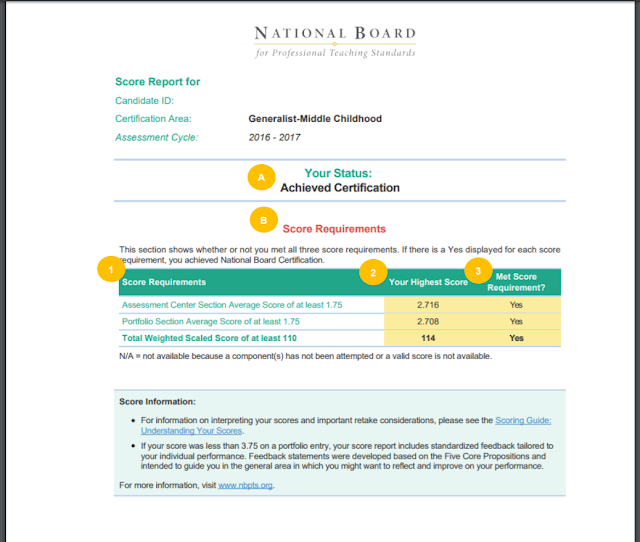


Here are screen shots of their scoring guide to help us understand the new system:


Tuesday, November 28, 2017

Agenda for November Cohort Meeting
There are still two meetings available to you this semester, if you'd like to attend. Choose either Lincoln High School this evening at 3:30, or Mountaineer Middle School at 3:00 Thursday.
Here is the agenda:
Here is the agenda:
Harrison County NBCT Cohort Support
November 28, 2017 November 30, 2017
Lincoln High School Library MMS Computer Lab
3:30-5:30 3:00-5:00
Purpose: To build a cohort of accomplished teachers committed to further development of their teaching skills through the medium of reflective practice.
Agenda
3:30 Sign-in and Announcements
3:45 Discussion of Component 3 Videos and Student Engagement
4:45 Develop a checklist for Component 4
5:25 Exit Tickets on Colored Notecards
"Piglet noticed that even though he had a very small heart, it could hold a rather large amount of gratitude."
--A.A. Milne
Wednesday, November 15, 2017
What Are Strategies?
Here is an article that discusses a strategy for helping students appreciate their own growth. It might be useful as an example for answering questions that ask, "What strategies..." I will tell you right now that I am not the poster child for remembering and using many different strategies.
Your components 2&3 ask for strategies for differentiation and engagement. Can you point to concrete methods similar to this one which you use to get the desired outcomes for your students?
What are some strategies YOU have used, heard of, or seen in other classrooms that you would like to try? They don't have to be for differentiation or engagement, but they could be. I'd love to see us brainstorming in the COMMENTS section.
Your components 2&3 ask for strategies for differentiation and engagement. Can you point to concrete methods similar to this one which you use to get the desired outcomes for your students?
What are some strategies YOU have used, heard of, or seen in other classrooms that you would like to try? They don't have to be for differentiation or engagement, but they could be. I'd love to see us brainstorming in the COMMENTS section.
Subscribe to:
Posts (Atom)